






Table of Contents
Toggle12pvoes refers to network devices that supply 12-volt power over Ethernet. The term describes switches or injectors that deliver 12 V DC to powered devices. Readers will learn what 12pvoes means and how it differs from other PoE gear. The article will show how to pick, install, and maintain a suitable unit.
Key Takeaways
- 12pvoes devices deliver a fixed 12 V DC over Ethernet and will only power equipment rated for 12 V, so always verify device input requirements before deployment.
- Calculate total and per-port wattage with at least a 20% safety margin and compare this to the switch’s power budget to avoid overloads and plan for future growth.
- Choose a managed 12pvoes switch when you need VLANs, QoS, SNMP, or port-level power control, and pick unmanaged models for simple plug-and-play sites to reduce cost and complexity.
- Use Cat5e or better cabling, keep runs short to limit voltage drop, label and group powered-device runs, and maintain adequate rack airflow for reliable 12 V delivery.
- Maintain firmware and monitor port power via SNMP or vendor tools, keep spare power modules/ports on hand, and prioritize vendors with strong warranty and rapid RMA support.
What “12PVoEs” Means And How It Differs From Other PoE Devices
12pvoes refers to devices that send 12 volts of DC power over Ethernet cabling. It differs from standard PoE because it uses a fixed 12 V rail instead of IEEE power classes. Many PoE devices use 48 V and follow 802.3af/at/bt standards. 12pvoes use simpler electronics and lower voltage levels. This difference affects safety, cable loss, and device compatibility. Devices that expect 48 V will not work with 12pvoes. Devices that accept a 12 V input will work without a separate adapter. 12pvoes often suit cameras, sensors, and low-power IoT gear. They also reduce component cost in some deployments. Installers must check device input requirements before deploying 12pvoes.
Key Technical Features To Expect From 12PVoEs
12pvoes devices present specific technical traits. The list below covers the main areas to inspect when shopping or planning a deployment.
• Power Budget, Port Types, And PoE Standards
A 12pvoes unit states a total power budget in watts. The device lists per-port voltage and current limits. Some models offer mixed port types such as PoE-out, PoE-passive, and non-powered ports. 12pvoes do not follow 802.3af/at/bt rules. The vendor should provide a clear compatibility chart. Installers must calculate per-port draw and total draw to avoid overload.
• Throughput, Switching Capacity, And Management Options
A 12pvoes switch lists switching capacity in Gbps. The unit lists forwarding rate per model. Managed 12pvoes offer VLANs, QoS, and SNMP. Unmanaged models provide plug-and-play operation. Choose a switch whose throughput matches network traffic. Management features help segment power and data for better stability.
Common Use Cases And Deployment Scenarios
12pvoes suits specific deployment scenarios. The sections below show where 12pvoes add the most value.
• Small Office And Retail Networks
A small office deploys 12pvoes to power VoIP phones, small cameras, and sensors. Retail stores use 12pvoes for POS terminals and displays that accept 12 V. The devices simplify wiring and remove bulky adapters. They also speed up installations in tight spaces.
• IP Cameras, Access Points, And IoT Devices
Many IP cameras accept 12 V directly. Access points with 12 V inputs can run from 12pvoes at short cable lengths. IoT sensors and gateways often include 12 V power ports. The reduced voltage lowers component cost for these devices. Installers should check cable length limits because 12 V suffers higher voltage drop than 48 V over long runs.
How To Choose The Right 12PVoE For Your Needs
Choosing the right 12pvoes device requires clear planning. The next parts explain power planning and management choices.
• Calculating Power Requirements And Future Growth
The buyer totals the wattage for each powered device. They add a safety margin of at least 20 percent. The buyer checks the switch’s total power budget against that sum. They plan for future devices and seasonal peaks. The buyer also checks per-port limits to ensure uniform distribution.
• Managed Vs. Unmanaged: When To Use Each
The buyer selects a managed 12pvoes switch when they need VLANs, traffic shaping, or SNMP monitoring. They select an unmanaged model for simple sites that need plug-and-play power. Managed units help debug power issues and isolate failing ports. Unmanaged units reduce cost and setup time.
Installation, Configuration, And Best Practices
Installers must follow clear steps to avoid downtime and safety problems. The sections below provide practical steps for cabling and basic configuration.
• Physical Installation And Cable Considerations
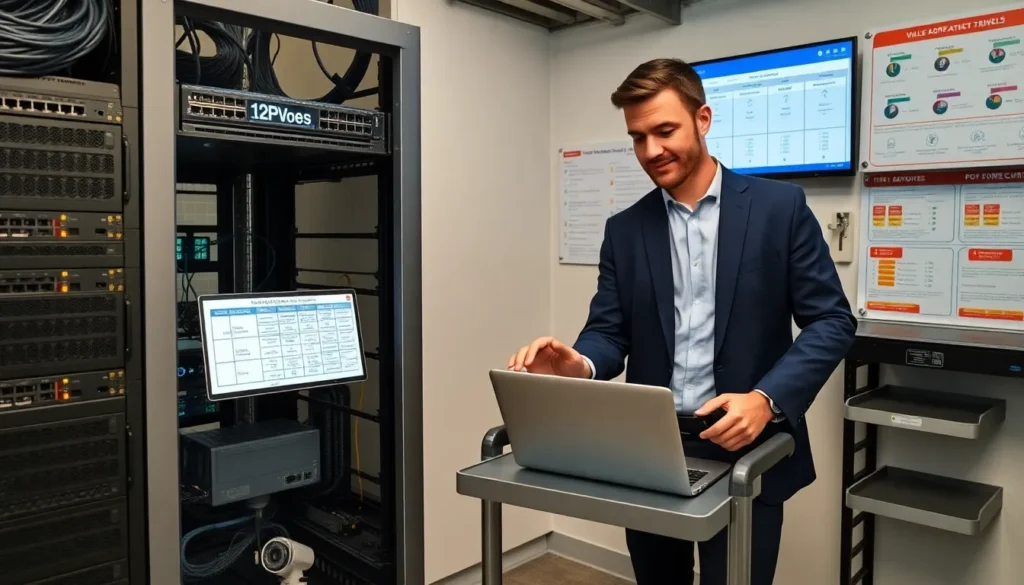
Installers mount the 12pvoes unit in a stable rack or shelf. They use Category 5e or better cable for data and power. They keep cable runs under the recommended maximum to limit voltage drop. They group powered device runs and label each cable. They ensure vents remain clear and maintain 10 to 20 percent free rack space for airflow.
• Basic Configuration Steps And Security Settings
The technician assigns a management IP to the 12pvoes switch. They enable SSH and disable unused services. They create admin and operator accounts with strong passwords. They apply VLANs to separate voice, cameras, and IoT traffic. They enable port-level monitoring if available. They set PoE schedules when devices need timed power cycles.
Troubleshooting And Maintenance Tips
12pvoes hardware requires periodic checks and quick diagnostics when problems appear.
• Common Issues And Quick Fixes
A common issue is a powered device that fails to boot. The technician checks cable continuity and verifies the port voltage. They swap ports to rule out a bad port. They replace the cable if voltage drop occurs. If the device still fails, they test the device with a local 12 V adapter.
• Monitoring, Firmware Updates, And Lifecycle Care
Operators schedule firmware updates during maintenance windows. They use SNMP or the vendor portal to monitor port power and fault states. They record firmware versions and update logs. They plan hardware replacement after the vendor end-of-life date. They keep spare power modules and spare ports in stock for quick swaps.
Buying Checklist And Final Practical Considerations
Buyers should follow a simple checklist before purchase.
• Budget, Warranty, And Support Factors
The buyer compares list price, power budget, and port count. They check warranty length and support options. They prefer vendors that offer on-site or rapid RMA service. They factor support costs into the total ownership cost.
• Compatibility, Scalability, And Environmental Constraints
The buyer verifies device input voltage requirements to ensure 12pvoes compatibility. They check rack space and ambient temperature ratings. They confirm the switch allows stacking or uplink expansion if traffic grows. They choose models with conservative thermal margins for warm sites.